
Consider this passage:
“During my time as President of ABC Society, I led a team of six in organising and executing the annual ball. This was a particularly difficult challenge for two reasons. First, given that we were a young society, we had little sponsorship; only £800 for a ball to accommodate 100 people. Second, <insert second challenge>. In order to resolve this challenge, I <insert action points>. Therefore, I believe that this experience demonstrates that I have the leadership skills necessary to succeed as a trainee solicitor at STRIVE LLP.“

This is what I call the ‘murder mystery’ style of writing. From the start of the paragraph, you bring the reader on a nice tour around your story, full of plot twists and car chases, until at the final sentence you finally reveal the ‘who dunnit’ (i.e. why you even talked about this experience - in this case, the sentence ‘I believe that this experience demonstrates that I have the leadership skills necessary to succeed as a solicitor at STRIVE LLP.‘).
Great if you want to make a name as the next bestselling thriller novellist, not so great for training contract applications.
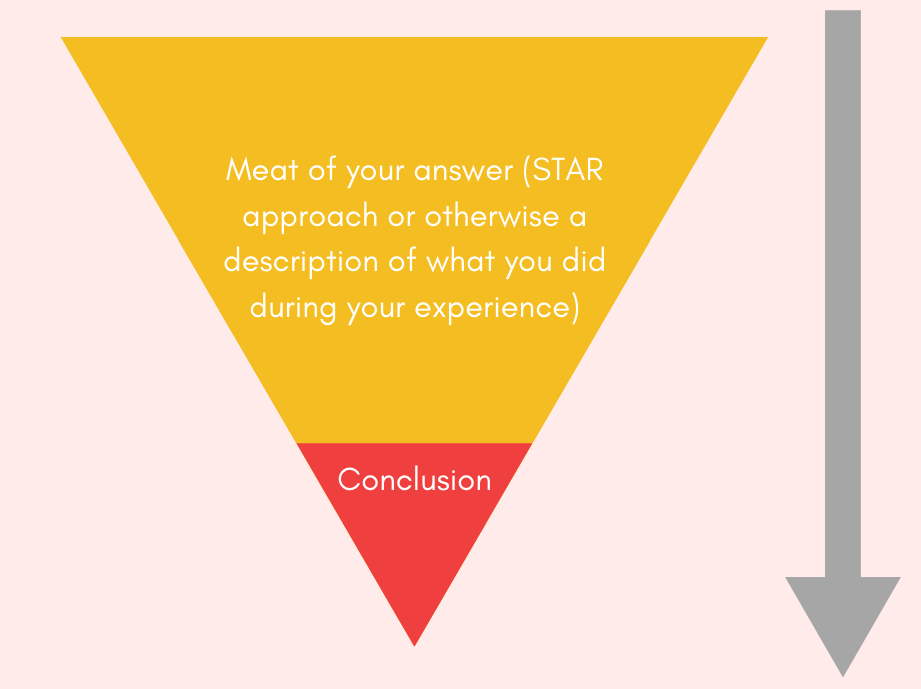
The upside-down pyramid: not a great approach!
Right now, the pyramid is upside down - the answer above first mentions the ‘meat’ of the response (i.e. describing what the author did during his/her experience), then reveals the conclusion (i.e. why s/he talked about this experience in the first place).
You can see why the reader’s eyes may glaze over from the beginning of the paragraph - if you don’t tell the reader why you are telling them this information before actually telling them the information, it is easy for their brain to switch off, simply discarding the information as waffle.
However, if you start off with first telling the reader why the imminently-arriving information is important (i.e. you should really listen up because I’m about to prove to you why I have leadership skills!), it is much easier for the reader’s mind to be more switched-on and receptive to the information.
Flipping the pyramid: putting your THESIS STATEMENT FIRST
It’s really easy to flip the pyramid on its head. Take out the final sentence of the paragraph, and chuck it at the beginning of the paragraph instead.
Let’s revisit the example we used above:
“During my time as President of ABC Society, I led a team of six in organising and executing the annual ball. This was a particularly difficult challenge for two reasons. First, given that we were a young society, we had little sponsorship; only £800 for a ball to accommodate 100 people. Second, <insert second challenge>. In order to resolve this challenge, I <insert action points>. Therefore, I believe that this experience demonstrates that I have the leadership skills necessary to succeed as a trainee solicitor at STRIVE LLP.“
The bolded sentence at the end is what is known as the ‘thesis statement’, or the ‘executive summary statement’. All this means is: if you could only express the core message of your entire paragraph within one sentence, what would that sentence be?
Now that you’ve identified your thesis statement, it’s time to put it at the beginning of the paragraph, like so:
I believe that I have the leadership skills necessary to succeed as a trainee solicitor at STRIVE LLP. This is evidenced by my time as President of ABC Society, where I led a team of six in organising and executing the annual ball. This was a particularly difficult challenge for two reasons. First, given that we were a young society, we had little sponsorship; only £800 for a ball to accommodate 100 people. Second, <insert second challenge>. In order to resolve this challenge, I <insert action points>.
Note that the ‘meat’ of the answer is now explicitly used as evidence to back up your thesis statement. Voilà!