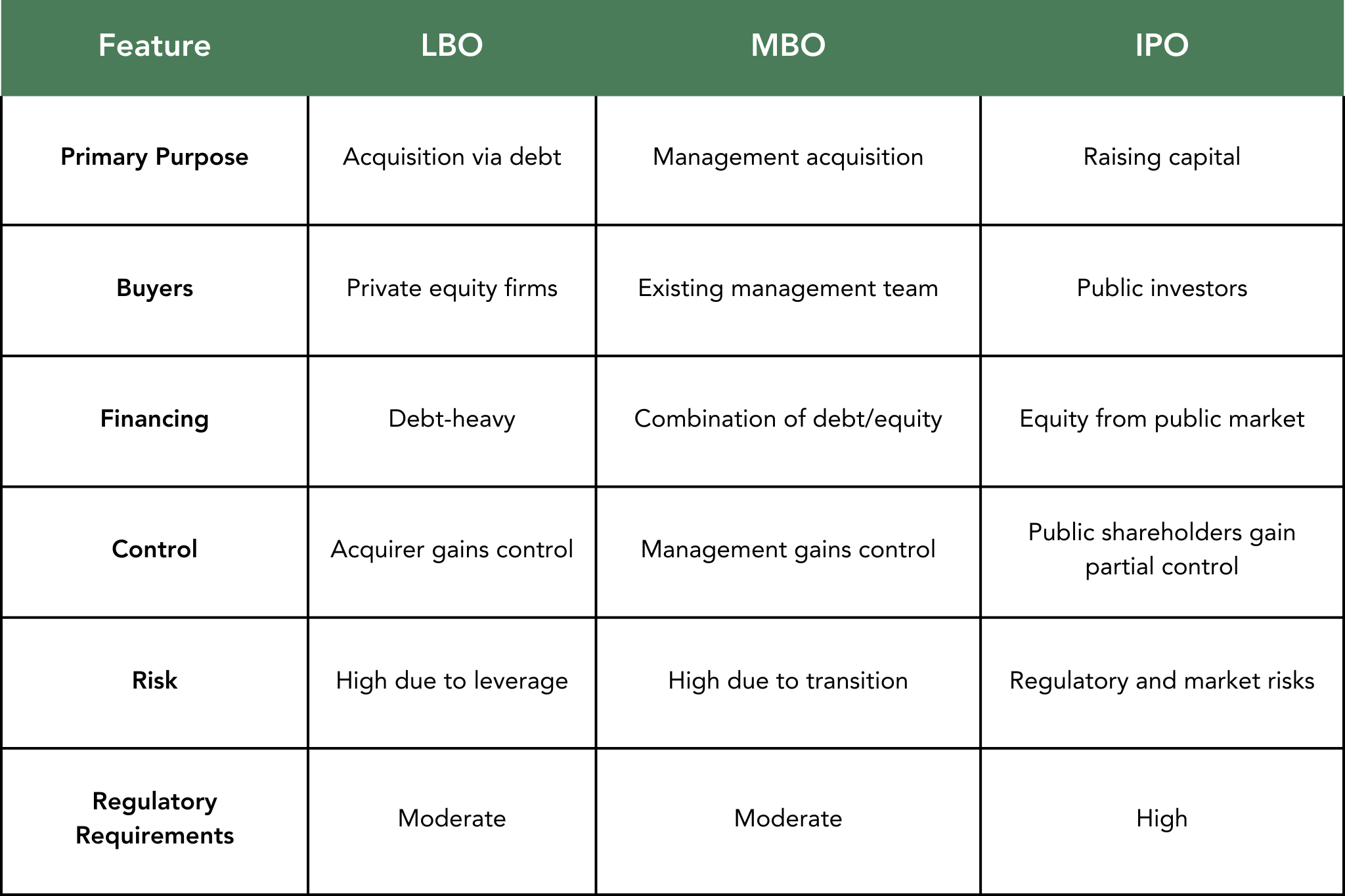
That’s a lot of acronyms! This article compares Leveraged Buyouts, Management Buyouts and Initial Public Offerings as financial strategies that involve significant changes in ownership or capital structure.
While they all end in Os, that’s mostly where the similarities end. Let’s take a closer look.
Leveraged Buyout (LBO)
The word “leverage” is another word for “gearing”, which in English means debt-to-equity ratio... which in PLAIN English means how heavily dependent a company/transaction is on debt (i.e. borrowed money). The “more leveraged” a company/transaction, the more heavily reliant it is on debt. Therefore, an LBO is a financial transaction in which a company is bought out (i.e. acquired) using a significant amount of borrowed money.
The assets of the company being acquired often serve as collateral for the loans. This strategy is typically employed by private equity firms (see this article for more detail on PE) to purchase companies with stable cash flows and valuable assets, allowing the debt to be repaid through the company's earnings.
Key Features:
High Debt Utilisation: The purchase is primarily funded through debt, minimising the equity investment required.
Asset-Backed Financing: The company's assets are used as collateral.
Risk and Return: Offers potentially high returns due to leverage, but also carries significant risk if the company's cash flows are insufficient to service the debt.
Management Buyout (MBO)
An MBO is a type of LBO where the existing management team acquires the company they manage. This often involves a mix of debt and equity financing, similar to a standard LBO, but with the management team as the buyer.
Key Features:
Management Control: The management team gains ownership and control of the company.
Continuity and Stability: Provides continuity in leadership, which can be beneficial for the company's operations and culture.
Financing: Typically involves personal resources, private equity, and seller financing.
Initial Public Offering (IPO)
An IPO is the process by which a private company offers its shares to the public for the first time, effectively turning what was once a private company into a public company - this means that if you go onto the websites of stock exchanges (e.g. that of London (LSE), New York (NYSE), Luxembourg (LuxSE)), you’ll be able to see the stock prices go up and down, and ordinary folks (like your grandma!) can buy and own a little “bit” of the company, since stock/shares = ownership. This is a way for companies to raise capital from public investors.
Key Features:
Capital Raising: Provides access to a large pool of public investors, raising significant capital.
Public Disclosure: Requires extensive disclosure and compliance with regulatory requirements.
Market Exposure: Increases the company's visibility and can enhance its reputation.
At a Glance